

 HL7 held its 40th FHIR Connectathon and 39th Annual Plenary, Working Group Meeting in Pittsburgh, PA, September 13-19, 2025. As always, this HL7 WGM and Connectathon proved to be lots of (satisfying) work and a great opportunity to reconnect with longtime friends and colleagues. The Working Group Meetings (WGMs) are held 3 times each year – in May, September, and January, with September’s meeting serving as the annual Plenary meeting.
This September, HLN participated in the Connectathon, attended the Plenary, and participated in the Public Health and Clinical Decision Support workgroup meetings throughout the week. HLN actively participates in the Helios Accelerator for Public Health effort, and during this connectathon, focused primarily on the FHIR Query and Response use cases for public health. The approach seeks to leverage existing FHIR API support to enhance public health access to data for high-priority functions while also being able to provide actionable information to care providers. It’s also worth to note that the Helios project has recently balloted an Informative Guidance document with the purpose to describe the application of the FHIR APIs approach to public health data sharing use cases.
This year’s plenary sessions focused on Artificial Intelligence (AI). After opening remarks from Chuck Jaffe (HL7 CEO), Tom Keane, MD, MBA, Assistant Secretary for Technology Policy, National Coordinator for Health Information Technology presented the first Keynote on Monday morning, touching on ASTP priorities of data liquidity, patient control of data, deregulation, curbing information blocking, HTI-4, TEFCA, and AI. Keynote speeches were also presented by Michael Pinsky, MD, CM, Dr hc, FCCP, MCCM, FAPS of the University of Pittsburgh; John Zimmerman, MDes of Carnegie Mellon University; Ahmad Tafti, PhD, University of Pittsburgh; Ananthaa Shekhar, MD, PhD, University of Pittsburgh; and Rema Padman, PHD, Carnegie Mellon University. These speakers were followed by Justin Chan, PhD, Carnegie Mellon; Hooman H Rashidi, MD, MS, FCAP, University of Pittsburgh; and Daniel Vreeman, DPT, FHL7, HL7 International’s Chief Standards Development Officer and Chief Artificial Intelligence Officer. All of the presentations were insightful, engaging, and thought provoking. Presentation slides are available to HL7 members.
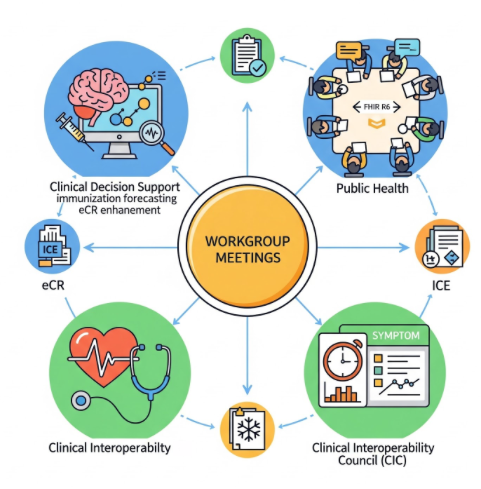
The workgroup meetings were varied and interesting. Our attendance this week in the Clinical Decision Support and Public Health workgroup meetings were with an eye to enhance and extend our decision support capabilities in immunization forecasting and electronic case reporting (eCR), as well as to track movement towards FHIR R6. We also joined the Clinical Interoperability Council (CIC) for a presentation of the new Symptom FHIR resource, which is a well structured and complete presentation of symptom information, including onset, duration, intensity, frequency, functional impact, and exacerbating and alleviating factors. This could potentially be useful in reportable conditions for eCR as well as ICE, HLN’s open-source immunization evaluation and forecasting software.
All in all, this Connectathon and WGM was a great time. As usual, it was a bit exhausting (with so much intensive brain-work!), but it was invigorating at the same time! HL7 has a wonderful group of folks to work with.