

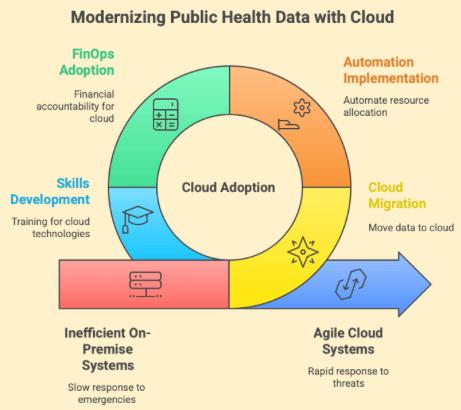
 When a public health emergency hits, how quickly can your agency scale up systems to meet demand? For many, the answer depends on infrastructure choices made years ago. As public health systems modernize, the shift from on-premise servers to cloud platforms is reshaping how agencies respond to crises, manage data, and allocate resources.
In a recent presentation, Michael Suralik, a public health informatics professional, outlined practical lessons for agencies moving their systems to the cloud.
Understanding the Cloud Landscape
Public health data systems generally operate in two models:
On-Premise: The agency owns and manages its servers and hardware.
Cloud-Based: A vendor manages infrastructure, offering scalability and remote access.
Within the cloud, two architectures dominate: virtual machine (VM)-based and cloud-native. VM-based models focus on stability and ease of migration by mimicking legacy environments and using many technologies that your staff are already familiar with. In contrast, cloud-native models demand a new infrastructure mindset and new skills to harness the full power of flexibility, automation, and long-term cost efficiency.
Building Agility Through Automation
A key benefit of cloud-native systems is automation. Tools like Terraform (for “infrastructure as code”) allow agencies to rebuild entire environments quickly—essential when switching vendors or recovering from outages.
Orchestration technology allows systems to spin down and give up resources at night and on weekends when not being used, and acquire more resources and spin up more containers when there’s a sudden surge of activity—all automatically without manual intervention.
Managing Costs with FinOps
Cloud billing can surprise new users. Instead of fixed expenses like data centers and hardware, cloud costs are tied to actual use – including computations, data storage, and transferring data in and out of the cloud. That first monthly bill often causes sticker shock.
However, there’s good news: a Hackett Group study on Amazon Web Services found that organizations achieve significant cost reductions over the first five years in the cloud as they learn to optimize operations. While the numbers may vary by vendor, the principle holds—efficiency improves with experience.
To accelerate those savings, Suralik recommends adopting FinOps—a culture of financial accountability for cloud operations. FinOps encourages ongoing collaboration among IT, finance, and program staff to make data-driven tradeoffs between cost, performance, and quality. Agencies continually inform, optimize, and operate—tracking usage, adjusting workloads, and automating processes that generate savings.
A practical approach: One organization estimated costs before committing to the cloud by building an analysis environment with only their most resource-intensive services. They ran load tests, gradually increasing resources until performance plateaued, then scaled horizontally by adding more service instances. They plugged these empirical observations into their cloud vendor’s cost calculator which produced a well-founded cost estimate. This also enables further exploration of tradeoffs: What if the system were tuned to support queries that take four seconds to complete instead of one second? What cost savings would that buy?
Lessons from the Field
Early cloud projects require patience and coordination. The team that performs an organization’s first cloud project is often “trailblazing” – doing the hard work of developing new standards, roles, and governance frameworks which later projects may follow and benefit from. Keep in mind: VM-based migrations and cloud-native builds are very different experiences—each needing its own trailblazing. Success with VM-based projects doesn’t automatically translate to cloud-native projects.
Cloud adoption also brings new benefits. Agencies gain:
Agility: Faster response to changing business needs and emerging health threats.
Resilience: Built-in redundancy that disaster recovery that reduces risk.
Focus: Less time spent managing hardware, more time improving public health programs and policy governance.
Building Skills for the Future
Training is essential. Free and paid courses from major cloud vendors, as well as platforms like Udemy and Coursera (look for instructors with certifications and strong reviews), can help staff build technical capacity. The FinOps Foundation, a neutral nonprofit under the Linux Foundation, also offers guidance on cloud financial management practices.
The Takeaway
Cloud strategies aren’t just about hosting data or systems in a new place – they represent a shift toward smarter, more responsive, and resilient public health systems. When you move to the cloud, you can shift your focus from managing infrastructure to your mission and governance. In an era where public health emergencies demand rapid response, that agility may be the most compelling reason to make the move.
Here is a recording of the “Best Practices for Cloud Strategies and Management” webinar that was presented as a part of the Data Modernization ECHO Series for PHIG Health Departments 2025.